
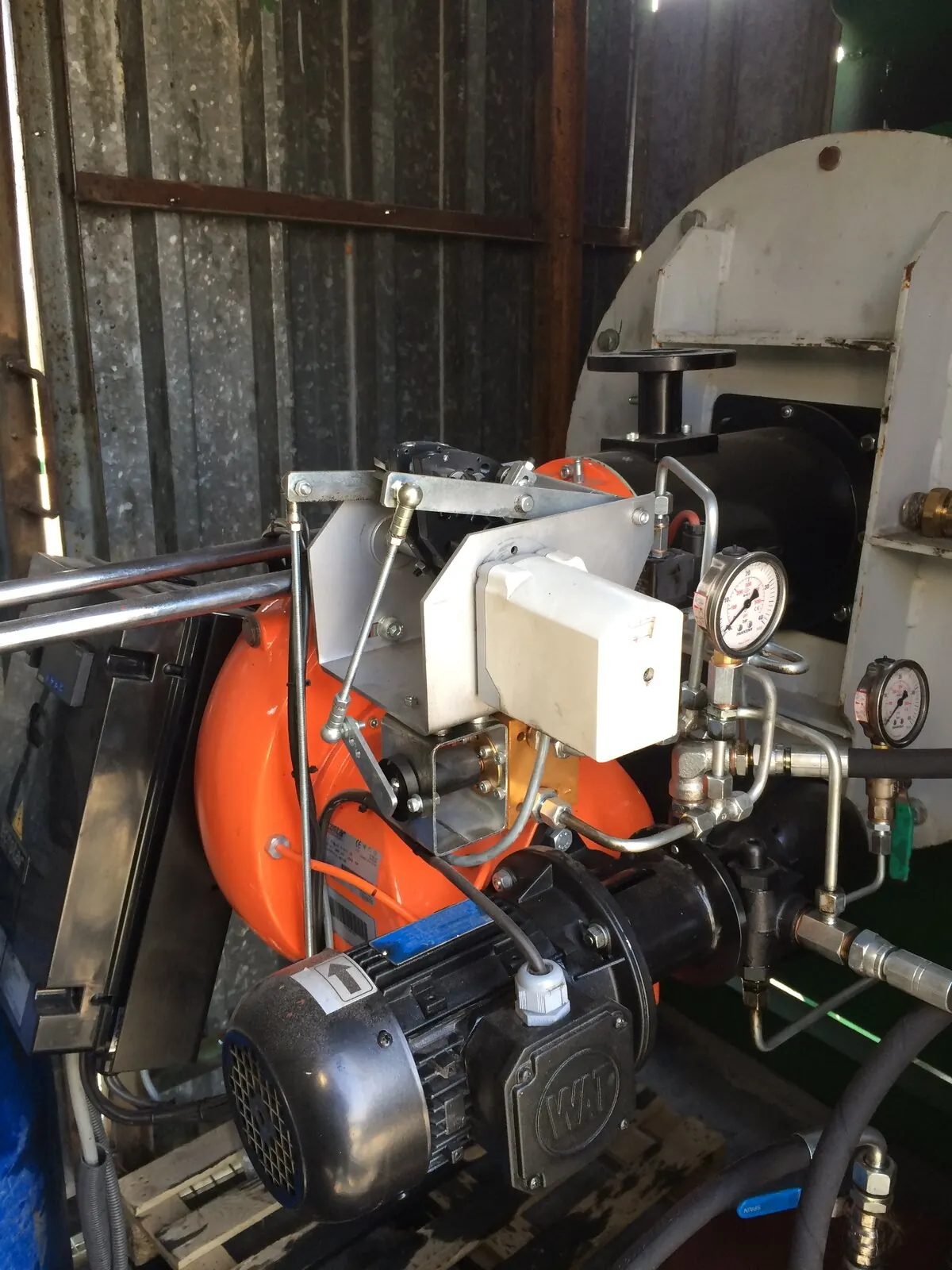
Burners for waste incineration plants.
Start-up and auxiliary burners for thermal waste treatment: combustion chambers, secondary combustion chambers, waste-to-energy and waste treatment lines. Selection, complete fuel supply system, commissioning and service.
In an incineration plant the burner does not burn the waste. It heats the line up at start-up, carries it through shut-down and makes sure the flue gas temperature in the secondary chamber never drops below the required minimum. It is the device that decides whether the plant runs in line with its permit.
What the burner does in an incineration plant
- Start-up — heating the combustion and secondary chambers to operating temperature before any waste is fed.
- Temperature support — the auxiliary burner switches on automatically when the flue gas temperature falls below the threshold, e.g. with wet or low-calorific waste.
- Shut-down — holding the temperature until no unburned waste remains in the chamber.
- Afterburning — supporting the secondary chamber in plants for industrial, medical and hazardous waste.
Burners we use
- FPB process burners — light oil, gas or dual-fuel, from 4.7 kW to 5.8 MW per burner. Flame tube and combustion block matched to the chamber; control panel and fan separated from the burner, so they do not work in high temperature.
- ECO 250–900 industrial burners — when more power is needed in a single burner, up to approx. 40 MW.
- Multi-burner systems — separate burners for the combustion and secondary chambers, each with independent control.
Note on model names: in the FPB series the number in the name is the output in kcal/h, not kW. The actual output is about 16% higher than the name suggests — a significant difference for the fuel balance and pump selection. Power ranges: FPB process burners, oil burners and dual-fuel burners.
A complete system, not just a burner
Our projects in thermal waste treatment plants have taught us one thing: most problems come not from the burner itself, but from everything around it. That is why we prepare the whole system.
- Fuel balance and pump selection — consumption with all burners running simultaneously, pump capacity with a margin for ring-main circulation.
- Oil system — double-wall tank with leak monitoring, 2 × 100% pumping unit (duty and standby pump), ring main, pressure protection for the burner pumping stations.
- Combustion air fans — airflow and pressure selection, damper or VFD control.
- Controls — burner management and signal exchange with the plant control system (permissives, temperature, power setpoint, alarms).
- Documentation — concept drawings and guidelines for the design team.
- Commissioning and service — settings, flue gas measurements, operator training and service during operation.
Our experience
We have completed several burner installations in incineration and waste treatment plants, and more are in progress. A typical configuration is two FPB light-oil burners with a total output of approx. 5 MW, electric ignition, a dedicated oil system and fans. We do not publish plant names.
What we need for a quote
- Type of plant and waste (municipal, industrial, medical, hazardous) and the required secondary chamber temperature.
- Burner output or data to calculate it: chamber dimensions, flue gas flow, temperatures.
- Available fuel: light oil, natural gas, LPG.
- Burner location and distance from the fuel tank.
- Plant control system and the expected scope of integration.
Frequently asked questions
Can the auxiliary burner burn waste oil?
No. The auxiliary burner must be fed with a fuel causing no higher emissions than gas oil, natural gas or LPG. That is why we use light-oil, gas or dual-fuel burners.
Oil or gas?
Gas, if there is a connection with sufficient capacity. Otherwise light oil with its own tank. A dual-fuel burner gives a backup if one fuel supply is interrupted.
Do you replace burners in existing plants?
Yes. We match the burner to the existing chamber and flange and, if needed, rebuild the fuel supply and controls.
Describe the installation — we will select the burners.
Power, fuel, chamber dimensions and control system. We reply within 48 hours, with no obligation.